Synthetic Cognition Strategy & Research

Minds built
to be understood

We engineer psychologically grounded synthetic personas and cognitive AI systems. Not prompt decorations — testable architectures with measurable behavior, validated stability, and governance by design.

Scroll

Not prompt engineering.
Persona architecture.

Most AI products treat personas as surface-level decorations — a name, a few demographic labels, a role prompt. The output looks plausible but collapses under scrutiny. We take a fundamentally different approach, grounded in decades of research spanning biology, psychology, and computational systems.

We treat large language models as human-text-trained cognitive simulators with stable default tendencies and unstable edge behavior. Models capture correlations between cognitive styles and linguistic patterns from training data — which is why psychologically precise cues can unlock specific reasoning clusters that generic instructions cannot reach. That insight is the foundation of everything we build.

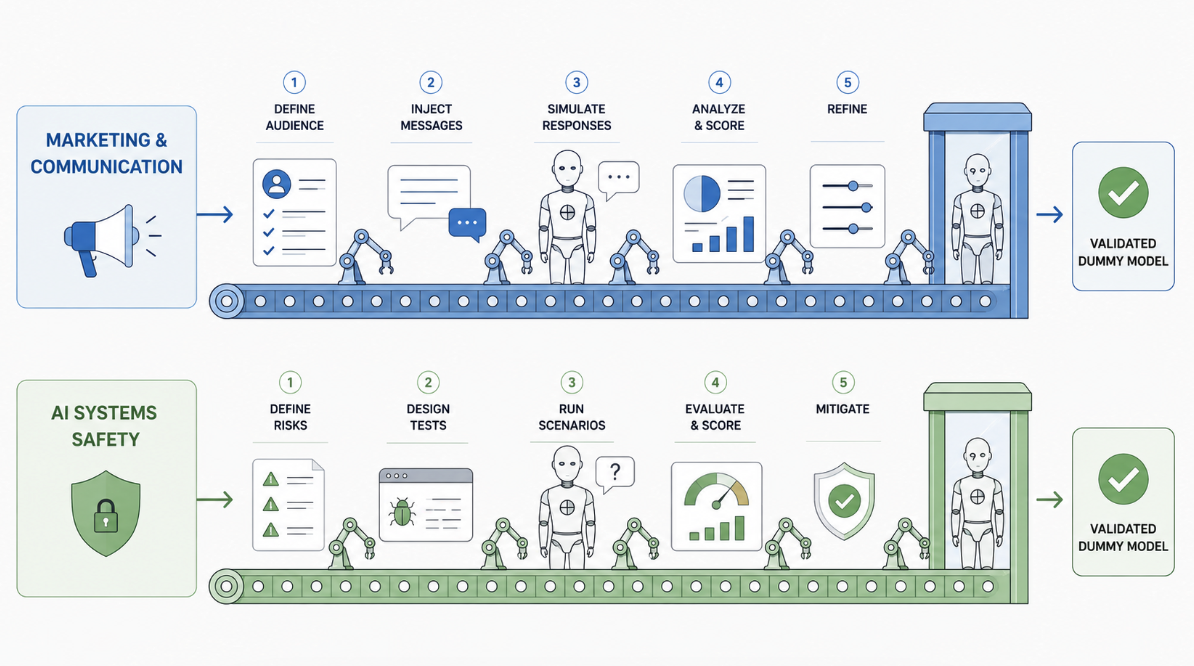
Every persona we construct is an experimentally testable architecture: defined trait profiles, measurable behavioral outputs, and validated consistency across tasks and models. We separate creation, simulation, and evaluation across independent models — eliminating the preference leakage that makes single-model validation unreliable.

01

Map Default Behavior

Profile model tendencies — compliance patterns, hedging, confidence drift, stylistic defaults — using our Behavioral Signature framework before building anything on top.

02

Steer with Psychological Precision

Apply cognitive, motivational, and personality-level modulators — using psychological verbs like contain, mirror, reframe, challenge — to move model behavior into target personality regions.

03

Stress-Test Stability

Run N=20–100+ repeated protocols with perturbation checks — name swaps, format changes, token substitutions, order effects — to find where persona coherence breaks before deployment.

04

Build System-Level Safeguards

Wrap models in governance layers: input/output screening, policy gates, behavioral screening batteries, risk-tiered access, and human-oversight integration.

05

Track Cognitive Impact

Monitor downstream effects on users, decision quality, and organizational thinking. LLMs shift attitudes and decisions — often more effectively than humans — and that influence demands measurement.

What we build

End-to-end infrastructure for synthetic cognition — from persona design through production-grade evaluation, behavioral analysis, and safety controls.

Synthetic Persona Architecture

Persona frameworks built on deep psychographic structure, not demographic shortcuts. Each persona is a testable hypothesis — trait profiles validated through cross-model generate/simulate/evaluate pipelines. Quality depends on signal-bearing features and mechanism fit, not descriptor length.

Behavioral Signatures

Our BSB framework maps how models actually behave: resilience under constraints, confidence calibration, drift patterns, and style deformation under structural pressure. Enables model-persona matching — routing the right model to the right simulation task based on behavioral envelope fit.

Psychology-Based Steering

Psychological cues activate latent reasoning clusters in training data. Our modulator framework — cognitive, motivational, perspective, personality, and contextual controls — shifts model reasoning trajectories in ways generic prompts cannot. The same model exhibits materially different decision quality depending on psychological framing.

Evaluation & Stability Engineering

Our research shows newer, more capable models are paradoxically more sensitive to tiny input perturbations. We measure output distributions across repeated runs, perturbation axes, and model families — because single-shot evaluation hides the stochastic failure modes that matter most in production.

Safety & Cognitive Risk Controls

Governance by design for high-impact contexts. Behavioral screening batteries for companion/social AI access tiering. Overpersuasion detection, vulnerability-aware deployment, and monitoring pipelines — because AI systems that simulate relationships require safety controls, not just age gates.

Multi-Model Council Systems

Orchestrated multi-perspective workflows that treat persona outputs as distributions, not singular truths. Explicit user modeling, expert/user fit layers, debiasing protocols, and intuition-capture loops — coupling persona simulation to uncertainty-aware decision support.

Where synthetic cognition creates value

From market simulation to cognitive security to the emerging science of human-AI co-evolution — our systems operate wherever AI behavior intersects with real human decisions.

Synthetic Audience Simulation

Generate behaviorally diverse customer and audience segments with psychographic depth — not just demographics. Test messaging, positioning, and product decisions against synthetic populations that exhibit realistic cognitive and emotional variation.

Persona-Driven Scenario Testing

Stress-test communications, UX flows, and policy language against personas representing rare, extreme, or vulnerable user profiles — including rare-personality simulations that push beyond default LLM agreeableness patterns.

Cognitive Security & Influence Detection

Detection systems for persuasion patterns, manipulation vectors, and adversarial influence in AI-generated content. LLMs carry embedded biases, guardrails, and institutional worldviews — we build tooling that makes this influence visible and measurable.

Multi-Model Decision Support

Council-based workflows that surface diverse model perspectives, explicit uncertainty, and debiased recommendations for high-stakes organizational decisions — treating AI outputs as probability distributions, not answers.

LLM Behavior QA & Compliance

Continuous monitoring for output drift, policy violations, and behavioral degradation across production AI systems. Automated persona consistency audits and drift diagnostics for regulated environments.

Cognitive Sovereignty Assessment

Tools and frameworks for organizations navigating the boundary between AI augmentation and cognitive dependency. Measuring how sustained AI collaboration reshapes thinking patterns — and where autonomy needs protecting.

Rigor that transfers to production

Our methods are built for deployment, not just publication. Grounded in interdisciplinary research spanning computational biology, experimental psychology, and applied AI systems.

Experimental Persona Validation

We separate persona creation, behavioral simulation, and psychological evaluation across independent models — eliminating single-model preference leakage and making validation defensible. Persona traits remain detectable from minimal behavioral probes when architecture is well designed, enabling low-friction QA at scale.

Our incremental expansion research demonstrates that persona quality depends on relevance and mechanism fit, not descriptor length. More details do not improve coherence. Scalable persona systems optimize for signal-bearing features, not verbose biographies.

  • Cross-model generate / simulate / evaluate separation
  • Sparse-signal validity checks from minimal behavioral probes
  • Signal-bearing feature optimization over descriptor volume
  • Rare-personality simulation beyond default agreeableness

Behavioral Stress Testing

We run 20–100+ iterations per experimental condition, analyzing distributions rather than cherry-picked outputs. Our model stability research reveals a counterintuitive finding: newer, more capable models are often more sensitive to minor input perturbations — well-known names destabilize assessments, formatting changes shift scores, and wider score ranges appear in newer model versions.

Perturbation protocols — name swaps, format variations, token substitutions, order effects — expose fragility that benchmark scores alone cannot surface. Cross-family model comparisons reveal transferability limits and hidden failure modes.

  • Repeated-run distributional analysis (N=20–100+)
  • Multi-axis perturbation protocols
  • Cross-model family transferability testing
  • Capability vs. stability paradox measurement

Ready to build synthetic
cognition that works?

Whether you need production-grade persona systems, behavioral evaluation infrastructure, or cognitive safety controls — let's talk about what rigorous AI looks like for your context.

Based in Europe · Working globally · hello@impersonato.com